Choosing the right window cleaning method for your building depends on three things: how tall the building is, what the architecture looks like, and what access is available at ground level.
Water-fed poles are best for buildings up to around 70 to 80 feet, abseiling suits high-rise and architecturally complex buildings with no height restriction, and cherry pickers work well for mid-rise buildings where stable ground access is available.
This guide covers how each method works, where it performs best, and how All Clean London uses all three across commercial buildings in London.
Quick Comparison: Abseiling vs Cherry Picker vs Water-Fed Pole
*Swipe left to view the whole table on mobile.
| Water-Fed Pole | Abseiling (Rope Access) | Cherry Picker (MEWP) | |
|---|---|---|---|
| Max height | Up to 70–80ft (7–8 storeys) | No limit | Up to ~130ft (varies by platform) |
| Ground access needed | Operative on foot | No vehicle needed | Vehicle and level ground required |
| Best for | Low to mid-rise buildings | High-rise, complex facades | Mid-rise with clear ground access |
| Chemicals used | None (pure water) | None (pure water) | None |
| London suitability | Excellent for most commercial buildings | Ideal for high-rises | Sites with clear ground access |
| Cost | Most cost-effective | Mid to high | Mid to high |
| HSE recommended | Primary method where possible | Where height demands it | Where access demands it |
| Requires roof anchors | No | Yes (tested eyebolts) | No |
| Disruption to traffic | Minimal | Minimal | May require permits or out-of-hours |
Water-Fed Pole Window Cleaning
Water-fed pole cleaning is the industry standard for low and mid-rise commercial buildings and the method recommended by the Health and Safety Executive (HSE) as the primary approach for avoiding working at height wherever possible.
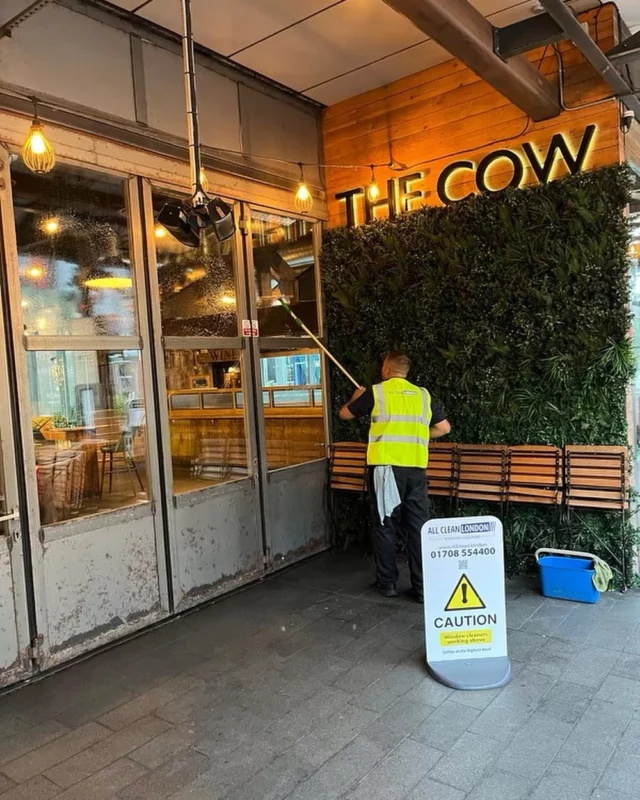
Telescopic poles extending up to 70 to 80 feet from the ground deliver purified water through a soft brush head that agitates the glass and frames before rinsing them clean.
Because the water has been filtered to remove all minerals and impurities, it evaporates completely clean, leaving no streaks, residue, or water marks. No squeegee is needed and no chemicals are used.
Best for:
- Buildings up to approximately 7 to 8 storeys (70 to 80 feet).
- Offices, retail units, apartment blocks, schools, and hotels on low to mid-rise sites.
- Buildings where keeping operatives on the ground is preferred for safety or insurance reasons.
Advantages:
- Safest method, operatives remain on the ground throughout.
- Cost-effective for regular contract cleaning.
- No chemicals, safe on all glass types, frames, and surrounding surfaces.
- Streak-free, longer-lasting results due to pure water delivery.
- Frames, sills, and reveals are cleaned simultaneously.
Limitations:
- Cannot reach buildings above approximately 7 to 8 storeys.
- Less effective on heavily soiled facades, deeply recessed glazing, or complex architectural details.
- Requires reasonable ground-level access for the operative and equipment.
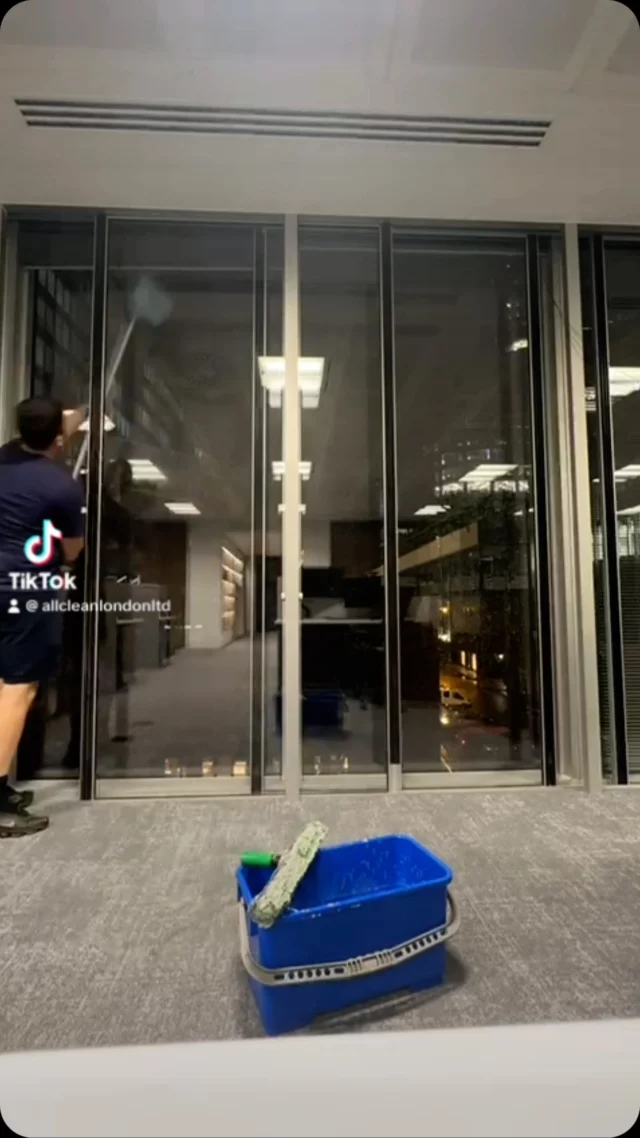
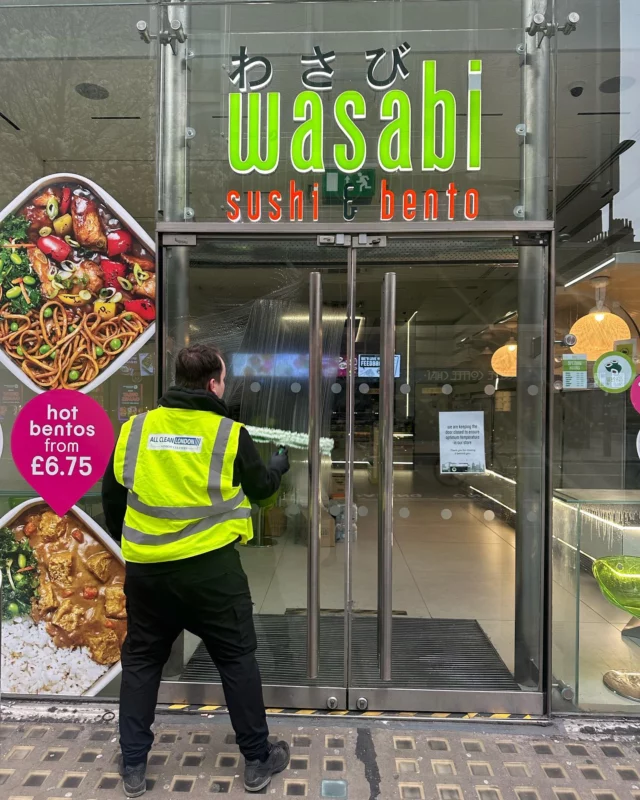
All Clean London deploys water-fed pole systems across the John Lewis & Waitrose retail estate, providing streak-free window and signage cleaning across multiple sites throughout London and the South East, scheduled around trading hours to avoid disruption to customers and staff.
For more on how this method works, visit our water-fed pole window cleaning page.
Abseiling Window Cleaning (Rope Access)
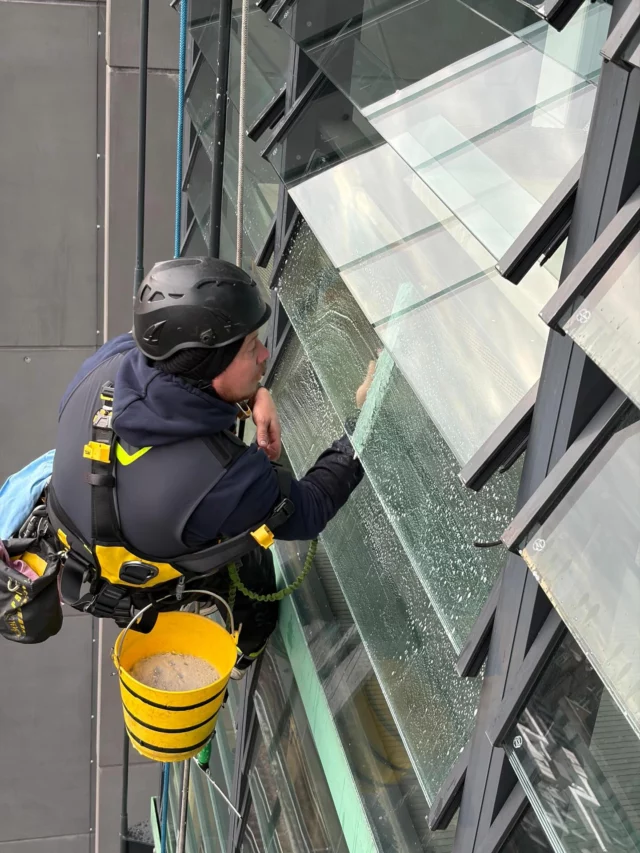
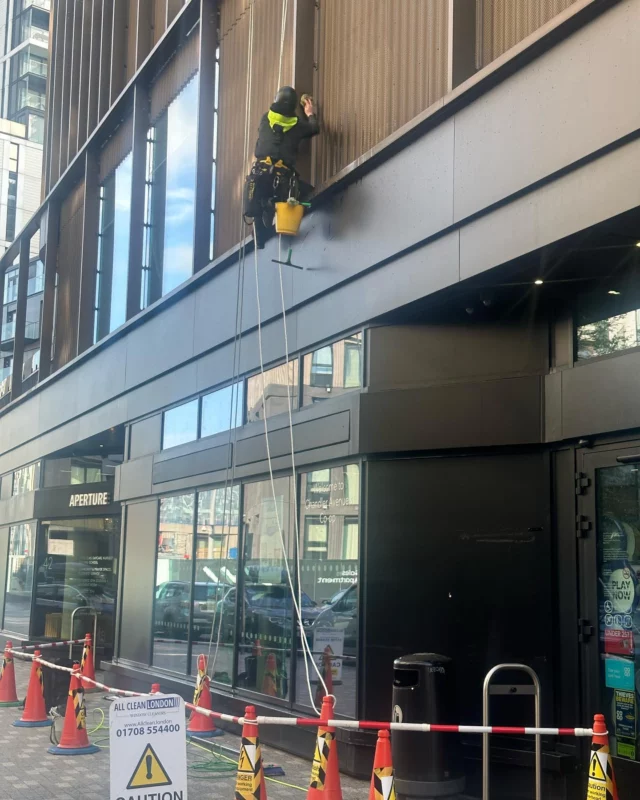
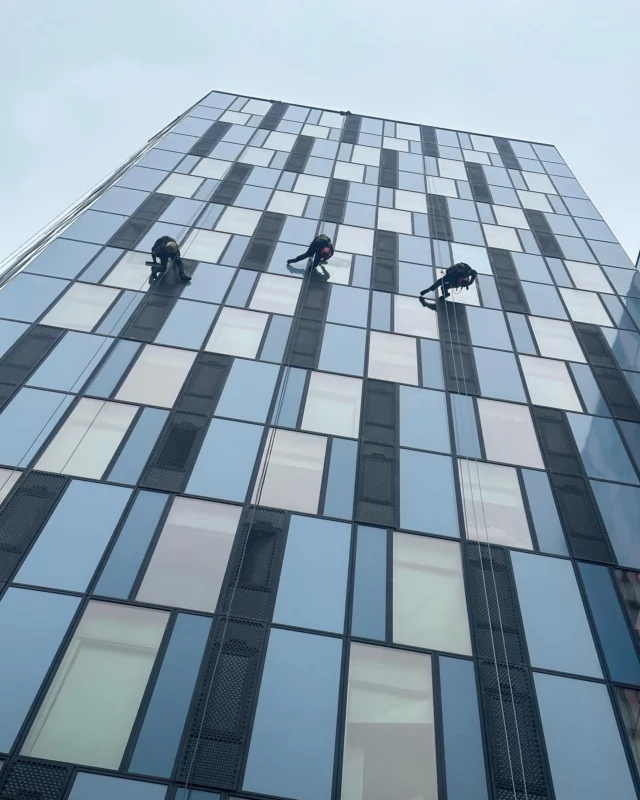
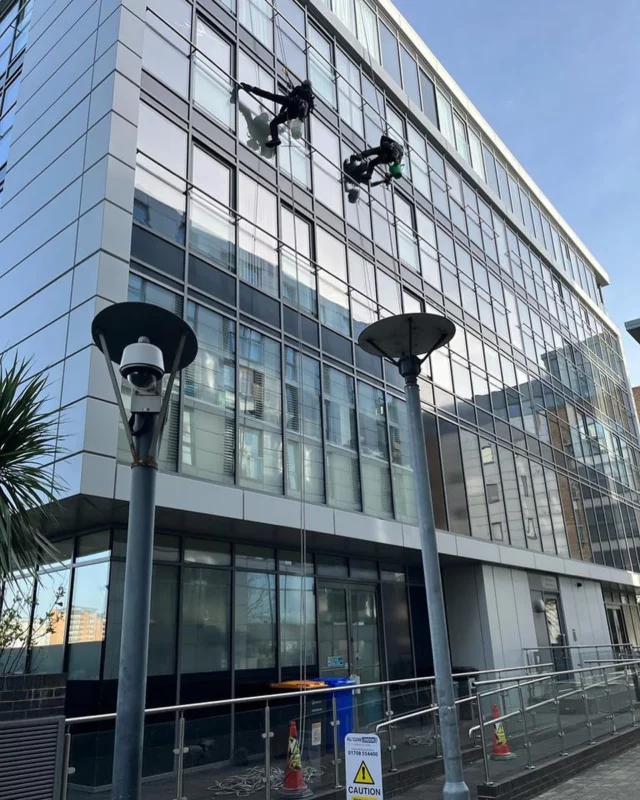
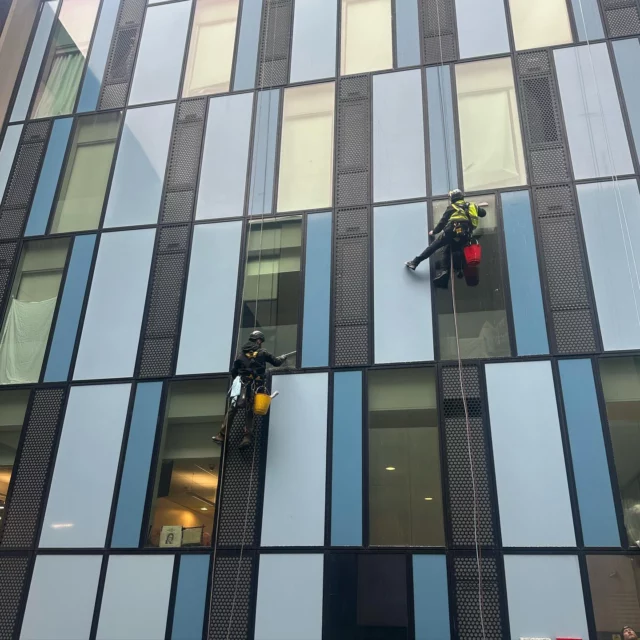
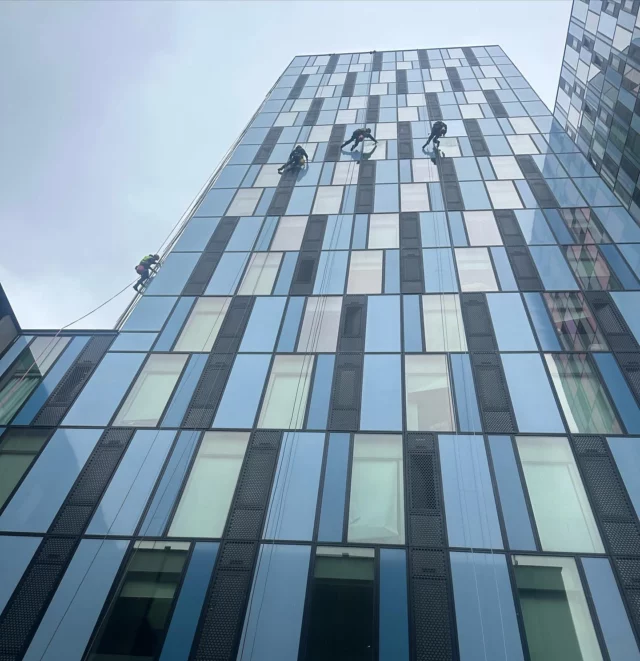
Abseiling, also referred to as rope access window cleaning, involves qualified technicians descending the exterior of a building using specialist ropes attached to tested anchor points or a Building Maintenance Unit (BMU) on the roof.
It is the most versatile method available for high-rise and architecturally complex commercial buildings, with no effective height restriction.
In London, where buildings range from curved facades, unusual angles, and cantilevered sections, abseiling is often the only method capable of reaching every part of a building’s exterior.
All Clean London’s rope access technicians are qualified to IRATA (Industrial Rope Access Trade Association) standards, the internationally recognised benchmark for rope access work.
Best for:
- High-rise buildings above 7 to 8 storeys with no height limit.
- Buildings with complex architecture, including curved facades, arched roofs, recessed glazing, and cantilevered sections.
- Sites with limited or no ground-level access for vehicles or equipment.
- London buildings where cherry picker access is impractical due to traffic, narrow streets, or restricted parking.
Advantages:
- No height restriction, suitable for any building regardless of floor count.
- Minimal ground footprint, no vehicles or large equipment needed at street level.
- Highly manoeuvrable, operatives can reach awkward angles, recessed areas, and unusual architectural features.
- Less disruption to pedestrians, traffic, and building occupants than ground-based equipment.
- Can be combined with pure water systems for a streak-free finish at height.
Limitations:
- Requires tested and certified roof anchor points (eyebolts) before work can begin.
- More specialised than water-fed pole cleaning, it requires IRATA-qualified operatives.
- Subject to wind speed and weather conditions, may need to be rescheduled in high winds.
- Higher cost per visit than water-fed poles for equivalent buildings.
All Clean London has managed rope access window cleaning across the Galliard Homes portfolio since 2014, 55 residential apartment blocks across London ranging from low-rise developments to 44-storey towers, where abseiling, cradle, and cherry picker access are deployed depending on the height and facade configuration of each building, all carried out by directly employed IRATA-certified operatives.
For more information, visit our abseiling window cleaning service page.

Cherry Picker Window Cleaning (MEWP)
Cherry picker cleaning uses a Mobile Elevating Work Platform (MEWP), a hydraulic arm mounted on a vehicle that lifts operatives in a basket to the required height.
It provides a stable, secure working platform that is well suited to mid-rise buildings where ground access is available and the height exceeds what a water-fed pole can reach.
Cherry picker access requires careful planning, where many streets have restrictions on large vehicles, and permits or out-of-hours scheduling may be required in congested areas. It is most commonly used where vehicle access and ground conditions are more straightforward.
For residential buildings, scheduling also needs to account for tenant communication, our guide on whether you need to notify tenants before window cleaning covers the legal requirements and best practice for managed buildings.
Best for:
- Mid-rise buildings of approximately 3 to 6 storeys where water-fed pole reach is insufficient.
- Buildings where a stable platform is needed for detailed or heavy-duty cleaning.
- Sites with clear, level ground access for the vehicle.
Advantages:
- Stable working platform, allows operatives to carry heavier traditional cleaning equipment.
- Good for detailed cleaning on facades requiring close access.
- No roof anchor points required.
- Suitable for buildings without existing rope access infrastructure.
Limitations:
- Requires clear, level ground access for the vehicle.
- May require permits or out-of-hours working on restricted streets.
- Cannot reach extreme heights, typically limited to around 40 to 60 metres depending on the platform.
- Less manoeuvrable than rope access on buildings with complex facades or restricted areas.
- Larger ground footprint can cause disruption to pedestrians and traffic.
All Clean London used cherry picker access at Canterbury Christchurch University where the configuration of the campus buildings made cherry picker access the most practical solution.
For more information, visit our cherry picker window cleaning service page.
How to Choose the Right Method for Your Building
| Building Type | Recommended Method |
|---|---|
| Low-rise (1 to 7 storeys), straightforward access | Water-fed pole |
| Mid-rise (3 to 6 storeys), clear ground access | Cherry picker or water-fed pole |
| High-rise (7+ storeys), complex architecture | Abseiling (rope access) |
| High-rise with limited ground access | Abseiling (rope access) |
| Any height, curved or recessed facade | Abseiling (rope access) |
| Full building programme (mixed heights) | Combination of methods |
For many large commercial buildings, the most practical solution is a combination of methods. All Clean London assesses each building individually and recommends the most appropriate approach for the site. You can see examples of this combined approach across our client portfolio.
What About BMU and Cradle Systems?
For very large or complex high-rise buildings, particularly purpose-built towers and skyscrapers, a Building Maintenance Unit (BMU) or cradle system may already be installed.
These are permanent or semi-permanent suspended platforms built into the building’s design, typically operated from the roof.
Where a BMU is available, it is often the most efficient and cost-effective method for full-building cleans on tall commercial towers.
Visit our cradle window cleaning page for more detail.
Does Your Building Have the Right Safety Infrastructure?
Before abseiling or any rope access work can take place, roof-level anchor points (eyebolts) must be tested and certified as safe.
If your building has existing eyebolts that have not been tested recently, or if you are unsure whether your building has the necessary infrastructure for rope access work, All Clean London can carry out a full eyebolt testing and certification inspection before any at-height work begins.
You can also read our complete guide to eyebolt testing in commercial buildings to understand what’s required and how often inspections need to take place.
Frequently Asked Questions
Water-fed pole cleaning is the most cost-effective method for buildings within its reach.
Abseiling carries a higher cost per visit due to the specialist qualifications and equipment required, but is often more cost-effective than cherry pickers on complex or high-rise London buildings where vehicle access is restricted.
Costs vary significantly depending on your building’s size, height, and access requirements.
Choosing the Right Window Cleaning Method
Water-fed poles, abseiling, and cherry pickers each have their place in commercial window cleaning. The right choice depends on your building’s height, architecture, and ground access.
For most high-rise and complex commercial buildings, abseiling is the most practical and versatile option.
For low and mid-rise buildings, water-fed poles deliver the safest and most cost-effective result. Cherry pickers work well for mid-rise sites with clear ground access.
At All Clean London, we use all three methods and assess each building individually to recommend the most appropriate approach.
Our IRATA-qualified rope access teams, pure water systems, and specialist access equipment cover commercial buildings of every size across the city, from apartment blocks and offices to landmark buildings and university campuses.
Request a free quote today and our team will advise on the right cleaning method for your building.