Pigeons and gulls are a familiar problem for London property managers. Fouled ledges, stained glazing and blocked gutters all add to maintenance costs, and droppings around entrances and walkways create a poor first impression for tenants, staff and visitors.
When it comes to bird proofing, the two most common solutions are bird spikes and bird netting. Both are humane and effective, but they do very different jobs. Choosing the wrong one can mean paying for a system that birds simply work around.
In this guide, we’ll explain where each method works best, how they compare, and what should be checked before any installation goes ahead on your building.
The Quick Answer
Bird spikes are best for stopping birds landing on narrow, linear perching points such as window sills, ledges, parapets and signage.
Bird netting is best for keeping birds out of larger or enclosed areas altogether, such as light wells, courtyards, recesses, balconies and roof plant areas.
In practice, many commercial buildings need a combination of both. The right choice depends on the species involved, how the birds are using the building and the layout of the affected areas, which is why every bird proofing project should start with a site survey.
Bird Spikes vs Bird Netting at a Glance
| Feature | Bird Spikes | Bird Netting |
|---|---|---|
| How it works | Prevents birds from landing on a surface | Physically blocks birds from entering an area |
| Best suited to | Window sills, ledges, parapets, signage, pipes and light fittings | Light wells, courtyards, recesses, balconies, canopies and roof plant areas |
| Typical buildings | Offices, retail frontages, hotels | Apartment blocks, mixed-use developments, shopping centres, loading bays |
| Visual impact | Visible close up, discreet from street level | Low visibility from a distance when correctly tensioned |
| Installation | Fixed directly along the perching surface | Fitted to a tensioned wire framework fixed to the building |
| Maintenance | Periodic clearing of debris caught between spikes | Regular inspection for damage, gaps and trapped birds |
| Main limitation | Does not stop birds using wider flat areas or recesses | More involved to install, and areas behind the net need access points for maintenance |
For a breakdown of materials, labour and access costs, see our guide on how much bird spike installation costs.
Where Bird Spikes Work Best
Bird spikes are a deterrent rather than a barrier. Blunt stainless steel spikes mounted on a UV-stable base make it impossible for birds to land comfortably, so they move elsewhere. They do not harm the birds.
Spikes are the most practical option for long, narrow perching points, including:
- Window sills and ledges
- Parapets and roof edges
- Shopfront and building signage
- Pipes, beams and light fittings
- CCTV brackets and other fixtures
Spike strips come in different widths and lengths. Wider ledges may need a wider strip or several rows, and longer spikes are used where gulls are the main problem.
Limitations of Bird Spikes
Spikes only protect the surface they are fixed to. If one ledge is treated and the next is left bare, birds will simply move along the building, so the full run of perching points needs to be covered.
They are also less effective on deep ledges, recesses and larger flat areas, where birds can find space to land around the spikes. Leaves, twigs and other debris can collect between the spikes over time, so they should be checked and cleared as part of routine building maintenance.
Where Bird Netting May Be More Suitable
Bird netting works by exclusion. Rather than deterring birds from landing, it physically stops them reaching an area at all. Netting is typically made from UV-stabilised polyethylene and fitted to a tensioned stainless steel wire framework fixed around the perimeter of the area.
The mesh size is matched to the species. Around 50mm is commonly used for pigeons, 75mm for gulls and 19mm for smaller birds such as sparrows and starlings.
Netting is usually the better choice for:
- Light wells and internal courtyards
- Balconies and communal walkways on apartment blocks
- Recesses, voids and areas behind signage
- Underneath canopies and soffits
- Roof plant areas and air conditioning units
- Loading bays and car park structures
Where pigeons are nesting rather than just perching, netting is often the only reliable long-term solution, as it removes access to the sheltered spaces they use to breed.
Limitations of Bird Netting
Netting must be correctly tensioned and fully sealed at the edges. Any gaps allow birds in and can leave them trapped behind the net, so installation quality matters as much as the product itself.
Where netting covers areas that need regular access, such as roof plant, gutters or drainage, access panels should be built into the installation. Netting also needs periodic inspection, as weather and other contractors working on the building can cause damage over time.
Spikes or Netting? Examples by Building Type
Offices
On office buildings, the most common problem areas are window sills, ledges above entrances and roof edges. Spikes are usually the right answer for these, with netting used for light wells and plant decks. Fouling on sills runs straight down the glazing, so it quickly undoes the results of regular office window cleaning.
Apartment Blocks
Pigeons nesting on balconies, in communal walkways and around roof plant are a frequent source of complaints to managing agents. Netting is often the most effective option here, as it closes off the sheltered spaces birds use for nesting. Installations need to be planned around residents’ access and coordinated with other scheduled work, such as apartment block window cleaning.
Retail Buildings
For retail properties, signage, shopfront canopies and ledges above entrances are the main targets. Spikes protect signage and ledges, while netting under canopies stops birds roosting directly above customers. Droppings on pavements outside entrances are both a poor first impression and a potential slip hazard, which is why bird proofing works well alongside retail window cleaning.
What Needs Checking Before Installation?
Active Nests and Wildlife Protection
All wild birds, their nests and eggs are protected under the Wildlife and Countryside Act 1981. It is an offence to intentionally take, damage or destroy the nest of any wild bird while it is in use or being built. Feral pigeons can breed at any time of year, so affected areas must be checked for active nests before any proofing work goes ahead, and the work planned around them.
Building Condition and Fixings
Spikes and netting are only as secure as the surface they are fixed to. Stonework, brickwork, render and cladding should be assessed so the right fixing method is used without damaging the building. For listed buildings or properties in conservation areas, owners should check with their local planning authority whether consent is required for visible fixings.
Cleaning and Disinfection
Existing fouling and nesting material must be removed and the area disinfected before installation. This helps fixings bond properly and removes the scent that draws birds back. Dried droppings can carry bacteria and fungal spores, so heavy fouling should be cleared by trained operatives using appropriate PPE. Our jet washing service is often used for this preparation, and our guide on cleaning bird droppings from windows covers the effect fouling has on glazing.
Access for Maintenance and Window Cleaning
Bird proofing should never block access for ongoing building maintenance. Netting and spikes need to be positioned so they do not obstruct window cleaning routes, rope access anchor points, gutters or roof plant. If your building relies on anchor points for rope access, it is also worth making sure they are covered by regular eyebolt testing and that gutter clearance remains possible after installation.
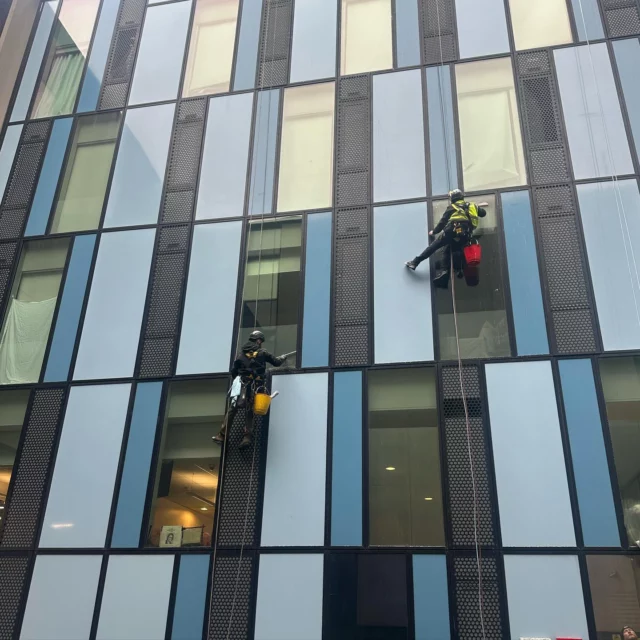
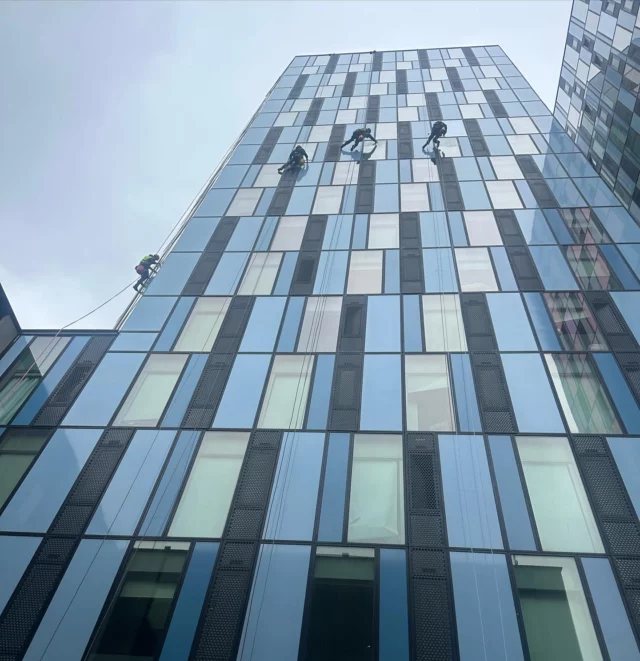
Working at height is a major factor in any bird proofing project. Depending on the building, installation may be carried out using cherry pickers or rope access, with the method agreed at survey stage.
What Should a Site Survey Assess?
A thorough site survey is what turns a general recommendation into the right solution for your building. It should cover:
- Species and numbers: pigeons, gulls or smaller birds, and how many are using the building
- How the birds are using the building: resting during the day, roosting overnight or nesting, as each needs a different level of protection
- Every affected area: not just the most visible ledges, but recesses, roof areas and plant spaces as well
- Surfaces and dimensions: ledge widths, run lengths and the materials fixings will go into
- Access: the safest access method, and any restrictions such as public footpaths, opening hours or residents’ access
- Visual considerations: frontage appearance, listed status and conservation area requirements
- Maintenance access: areas that must stay accessible for window cleaning, gutters and plant
- Existing fouling: the level of cleaning and disinfection needed before installation
From the survey, you should receive a clear recommendation for spikes, netting or a combination of both, along with a risk assessment and method statement for the work.
Why Choose All Clean London?
Since 1979, we’ve helped property managers, facilities managers and managing agents keep commercial buildings across all 32 London boroughs clean, safe and well maintained.
Our pigeon netting and spikes service is delivered by the same teams that carry out our commercial window cleaning, so bird proofing can be planned alongside your existing maintenance schedule. We hold ISO 9001, 14001 and 45001 accreditations, are CHAS and SafeContractor approved, and supply full risk assessments, method statements and insurance documents for every job.
With our own cherry pickers and IRATA-trained rope access operatives, we can reach even the most awkward areas of your building. Every job is also backed by our Money Back Guarantee.
Protect Your Building
Bird spikes and bird netting both have their place. Spikes are the efficient choice for ledges, sills and signage, while netting is the most reliable way to keep birds out of larger and sheltered spaces. For most commercial buildings, the best result comes from using each where it works best.
If birds are causing problems on your building, request a bird proofing survey or call our team on 020 7127 8079 for expert advice.